Psychological Distance and Reflective Writing in Family Caregiving
We conducted a 3-week field study with 47 family caregivers using a LINE chatbot for daily reflective writing. Analyzing how temporal, spatial, and social psychological distance from the care recipient shapes reflection, we identified two distinct writing styles: an expressive, proximal mode and a calm, analytic, distal mode.
Overview
Therapeutic writing—such as expressive writing or reflective journaling—is a well-established method for coping with the stress of family caregiving. However, family caregivers spend much of their time close to the person they care for and can become emotionally enmeshed with them, so it has remained unclear when and under what circumstances reflection is most effective.
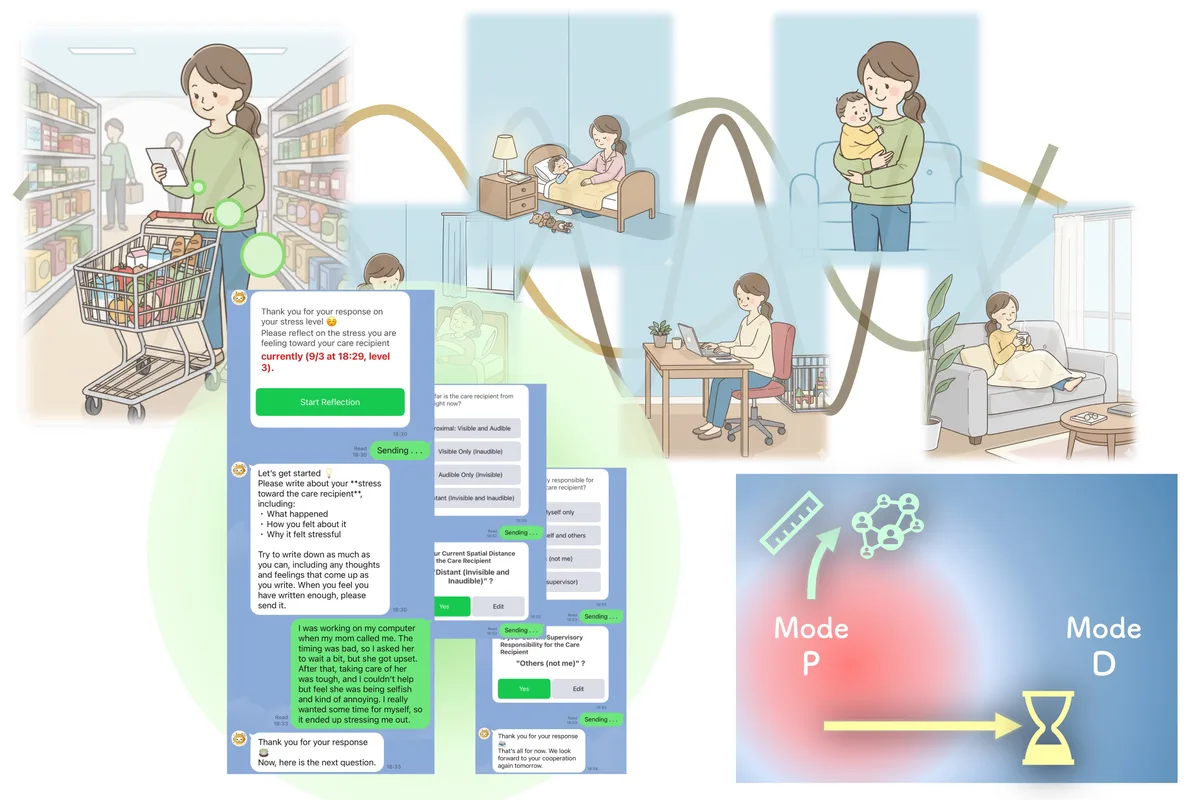
Drawing on Construal Level Theory from psychology, this study examined how temporal, spatial, and social psychological distance from the care recipient shapes the content and effect of reflective writing. We built a chatbot on LINE and conducted a 3-week field study with 47 family caregivers, collecting daily stress ratings, reflective writing entries, and situational context, such as physical proximity to the care recipient and who was providing care at the time.
Our analysis found that reflections written psychologically close to the care recipient and the event tended to be emotionally rich, detailed, and focused on the care recipient, while reflections written psychologically distant tended to be calmer, more analytical, and focused on the caregiver's own feelings. We characterize these as two distinct reflective styles: Mode P (Proximal), centered on emotional release, and Mode D (Distal), centered on objective reflection.
Participant interviews revealed a trade-off: proximity preserved vivid memory of the event, while distance allowed for emotional calm and a more objective perspective. This work proposes a new design direction: distance-aware Just-in-Time Adaptive Interventions (JITAIs) that adapt the timing and framing of support based on caregivers' psychological distance from stressful events.
Technologies & Methods
Results & Achievements
- Conducted a 3-week field study with 47 family caregivers, collecting 958 reflective writing entries
- Quantitatively confirmed that temporal, spatial, and social distance significantly shape the content and focus of reflective writing
- Proposed two reflective modes: Mode P (emotional release) and Mode D (objective reflection)
- Paper accepted to ACM IMWUT (UbiComp '26)
Related Publications
“Two Modes of Reflection: How Temporal, Spatial, and Social Distances Affect Reflective Writing in Family Caregiving”
Shunpei Norihama, Yuka Iwane, Jo Takezawa, Simo Hosio, Mari Hirano, Naomi Yamashita, Koji Yatani.
To Appear · ACM IMWUT (UbiComp '26) (September 2026)